

Narrow by
-

Environmental Scan: Pattern Recognition (2003)
19 December 2003
Cathy De Rosa, Lorcan Dempsey, Alane Wilson
The Scan, acclaimed in the library community, is a comprehensive high-level view of the current information landscape and the significant issues and trends facing libraries and other public-serving institutions.
-
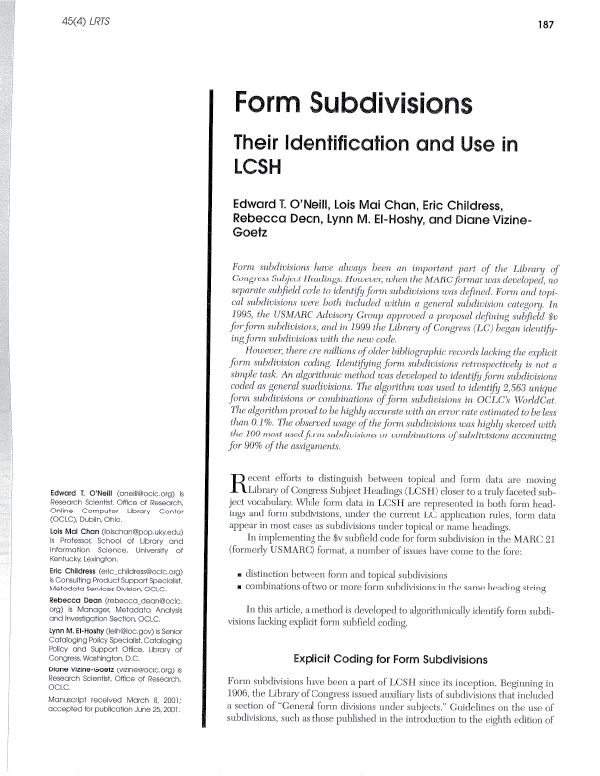
Form subdivisions their identification and use in LCSH
1 January 2001
Edward T. O’Neill, Lois Mai Chan, Eric Childress, Rebecca Dean, Lynn M. El-Hoshy, Diane Vizine-Goetz
The Library of Congress Subject Headings have long included form subdivisions, but until 1995, there was no dedicated MARC subfield to distinguish them from topical subdivisions. A new subfield code ($v) was introduced to address this, but older bibliographic records lacked this coding. To retroactively identify form subdivisions, OCLC developed an algorithm that accurately detected over 2,500 unique form subdivisions in WorldCat, with an error rate under 0.1%. Usage was highly concentrated, with the top 100 subdivisions accounting for 90% of occurrences.
-

FAST: Faceted Application of Subject Terminology: Principles and Application
Lois Chan, Edward T. O'Neill
FAST: Faceted Application of Subject Terminology: Principles and Application is a foundational resource that introduces and explains the development, structure, and use of the FAST (Faceted Application of Subject Terminology) system.
-
Research Libraries, Risk and Systematic Change
James Michalko, Constance Malpas, and Arnold Arcolio
-
Seeking Synchronicity: Revelations and Recommendations for Virtual Reference.
Lynn Silipigni Connaway, Marie L. Radford
The report is based on a multi-year study funded by the Institute of Museum and Library Services (IMLS); Rutgers, The State University of New Jersey; and OCLC. A rich resource for further exploration of this important topic, it includes valuable statistics, lists of references, additional readings, and specific recommendations for what libraries and librarians can do to move VR forward in local environments. Today's students, scholars and citizens are not just looking to libraries for answers to specific questions—they want partners and guides in a lifelong information-seeking journey. By transforming VR services into relationship-building opportunities, libraries can leverage the positive feelings people have for libraries in a crowded online space where the biggest players often don't have the unique experience and specific strengths that librarians offer.
