

Presentations
Narrow by

Case Studies from Project Passage Focusing on Wikidata’s Multilingual Support (video)
This webinar highlights some key lessons from our experiences in the OCLC Research’s Linked Data Wikibase Prototype (“Project Passage”) regarding Wikidata’s multilingual support. It focuses on two case studies from the upcoming report on the pilot: Chinese descriptions and representing works and their associated translations.
Topics: Linked Data, Wikimedia, Works in Progress
The Limits to Growth: An Introduction
Baltimore, MD (USA)
While colleagues in the circulating library have developed sophisticated collective collection strategies as an alternative to building comprehensive collections, the growth imperative has gone relatively unexamined in special collections. This panel explores our responsibilities related to resource allocation and collection growth in the age of climate change, and imagine what it might look like to alter our growth patterns.
Topics: Collective Collections
A User-Centered Perspective: Integrating Qualitative Research Methods into the Study of Information Behavior
Mexico City (Mexico)
In this keynote presentation, Silipigni Connaway delves into data collection methods, information behavior research methods, making a case for qualitative research methods and providing examples in recent research of how this has been implemented.
Topics: Research Methods
Using Qualitative Methods for Library and Information Science Research: An Interactive Workshop
Mexico City (Mexico)
In this workshop, participants learned about qualitative research data collection methods and tools, focusing on interviews, structured observations, usability testing, and ethnographic research. Participants also went through a few exercises to put the knowledge into action.
Topics: Research Methods

OCLC RLP SHARES Policy Rethink: Outcomes and Next Steps (video)
The SHARES resource sharing consortium’s leadership and participants recently concluded a year-long exercise aimed at rethinking SHARES policies and values. The goal of the exercise was to ensure that SHARES remains on track to play a vibrant role in a resource sharing future where the emphasis is always on the patron, and where consortia will increasingly be the venue for the advancement of library collections and services. Learn about the work in this webinar.
Topics: SHARES, Works in Progress
The Costs of “Open”: Preliminary Results from a Global Survey
Manchester (UK)
OCLC conducted a worldwide survey in 2018 that focused on libraries’ ambitions, realities, and investments in support of open content. Here we examine definitions of “open” and share preliminary findings from more than 700 responses on library investments, assessments, and planning.
Topics: Open Access
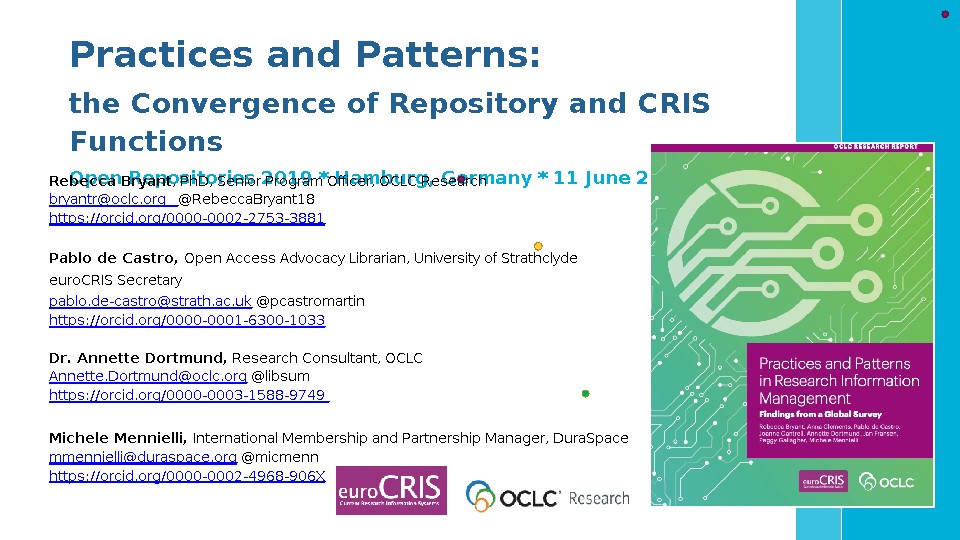
Practices and Patterns: The Convergence of Repository and CRIS Functions
Hamburg, Germany
The report Practices and Patterns in Research Information Management: Findings from a Global Survey, shines a light onto the ever increasing coupling of its workflows to those traditionally associated with research information management (RIM, or CRIS) systems. Learn more about the findings of the survey conducted as part of this research.
Topics: Research Information Management
Designing a "Point of Selection" Study Using Simulations: From Trailhead to Terminus
Minneapolis, MN (USA)
Members of the Researching Students’ Information Choices (RSIC) project share results from a study on “point of selection” behavior, that is, the point at which an information seeker determines a resource meets their information need.
Topics: Information Literacy

An "Open" Discussion: Findings from an OCLC Survey of Open Content Costs and Benefits
Espoo/Helsinki (Finland)
OCLC conducted a survey that focused on libraries' ambitions, realities, and investments in support of open content that collected data about library open content activities across multiple internal silos. In this presentation, representatives from OCLC Research share preliminary findings from this global survey.
Topics: Open Access
Fast and Discriminative Semantic Embedding
Gothenburg, Sweden
We present a novel, effective and efficient method for term and document embedding method. Our experiments show it outperforms state-of-the-art methods in terms of the STS benchmark and subject prediction when trained on the same datasets, while at the same time being computationally cheaper by orders of magnitude.
Topics: Semantic Embedding